

The Trillion-Dollar Question: Are We in an AI Bubble?
Some thoughts about bubbles, AI and the scary two conflicting ideas in our minds at the same time.

Guys, I have to be honest with you. This is the question that keeps people awake at night sometimes.
If you open your feed or read the news right now, it’s crazy.
Half of the people are shouting that AI is the new electricity and will save humanity.
The other half is showing scary charts comparing the market today with the crash of 1999, saying it’s all going to burst tomorrow.
I spend a lot of time analyzing trends and trying to understand where the world is going. And right now? The noise is very, very loud.
I was thinking this week about crises coming, where to put investments, and how to prepare for the future.
The question “Are we in an AI bubble?” is not just intellectual curiosity. It is a trillion-dollar question that affects our wallets and our decisions.
So, let’s do an exercise of radical honesty here. Let’s think out loud together, look at some real data (because good vibes don’t pay the bills), and try to understand the two sides of this crazy coin.
First, a quick detour into history (The Dot-com Lesson)
Before we start fighting, we need to define “bubble.” A bubble is when the financial price of something gets completely disconnected from its real value.
Here is the historical trick that always gives me some comfort: You can have a financial bubble and a revolutionary technology at the same time.
Do you remember the year 2000? The “dot-com” bubble burst. It was ugly. Stupid companies that sold pet food online with zero plan disappeared overnight. Even giants like Amazon saw their stocks fall 90%. (Imagine your investments melting 90%... scary, right?) It was a financial bloodbath.
BUT, the internet did not go away. It really changed everything. The companies that survived the crash ended up dominating the world for the next 20 years. That history is important because it shows the pain is financial, but the progress is technological.
SIDE A: No, there is no bubble
(We are just building the foundation)
The argument here is that we are in a phase of massive “Capital Expenditure” (CAPEX).
We are building the roads and bridges for a new era. It is not pure speculation; it is a necessary construction.
1. The profits are real, not imaginary dreams
Different from previous booms where companies had no revenue, the gains today are tangible.
Fact: Look at Nvidia. They are not selling dreams; they are selling hardware that people are desperate to buy. They reported Q2 FY2026 revenue of US$46.7 billion, up 56 % year-on-year.
2. Real productivity is happening now
AI is already delivering economic value, not just future promises.
According to the McKinsey & Company “State of AI 2025” survey, organisations that are using AI report measurable value. Also, the global market for AI hardware (chips) is estimated at US$44.3 billion in 2025, quadruple its 2021 value.
The verdict on this side: It’s not a bubble because the tech is being used in business today. The investment is in the plumbing of the future.
SIDE B: Yes, it is totally a bubble
(The math doesn’t match)
This side of the argument is colder and more mathematical. The argument is: the money invested in the infrastructure is MUCH bigger than the money AI is generating back in sales.
1. The huge “Revenue Gap” problem
The global AI market size has widely varying estimates. One source says it will be about US$638 billion in 2025. But infrastructure spending by large tech companies (capex) is projected to exceed US$490 billion by end of 2026.
So there’s a gap: billions spent now to build infrastructure, but revenues are still “only” hundreds of billions, not yet trillions.
2. Too much concentration and corporate FOMO
The stock market is being carried on the shoulders of very few companies. And if those stumble, the ripple would be enormous. A recent report suggests we may already be seeing signs of “bubble‐like” concentration.
Also, many companies are jumping into AI because it is trendy, but few have clear, scaled business use‐cases yet.
3. Physical limits (Energy and scale are real)
Training the next generation of models costs enormous amounts of compute and electricity. For example, a study shows the hardware cost and power demands are doubling every year for leading AI supercomputers.
If cost goes up 10x but performance only improves 20 %, the business case weakens.
The Gartner Hype Cycle: A Map for the Chaos
I believe we are watching this whole process through the lens of the Gartner Hype Cycle, which is an excellent tool for understanding how new technologies move through the public mind.
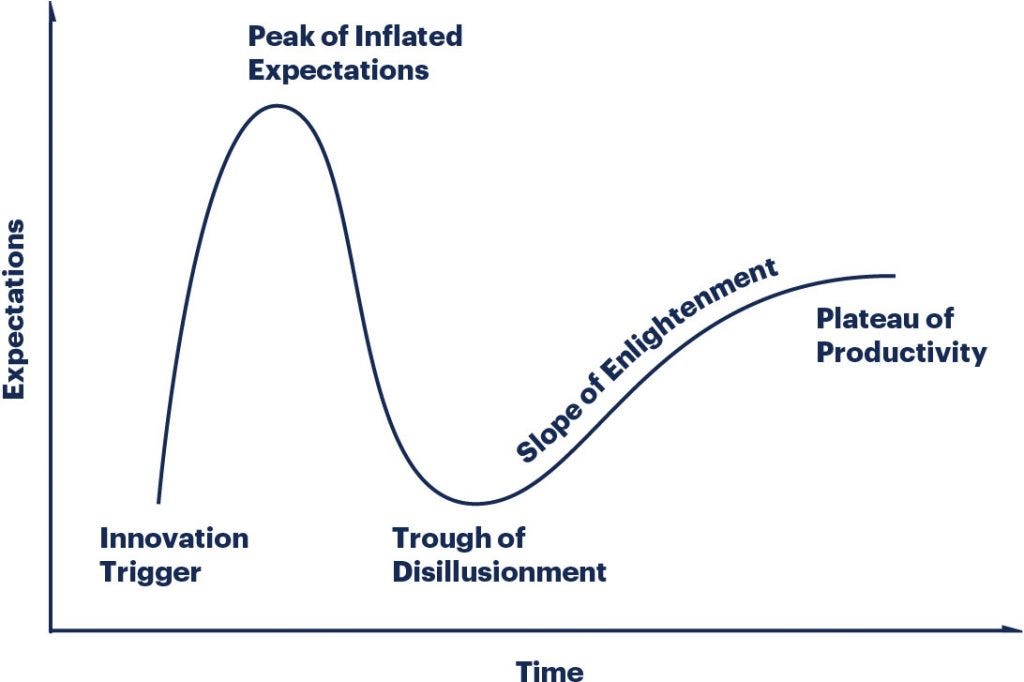
This model says every big technology goes through five stages:
Innovation Trigger: A breakthrough starts the interest (e.g., ChatGPT launch).
Peak of Inflated Expectations: Hype takes over. Everyone says it will solve world hunger next week. Money is thrown everywhere, and prices become crazy.
Trough of Disillusionment: The bubble pops. The technology fails to deliver on the exaggerated promises. Companies fail. The media stops covering it. This is the valley of disappointment where the hard work starts.
Slope of Enlightenment: People who survived start to figure out what the tech is actually good for. Real products and best practices begin to appear.
Plateau of Productivity: The technology is finally mature, stable, and delivers clear value (e.g., Cloud Computing or the Internet today).
Where is AI today?
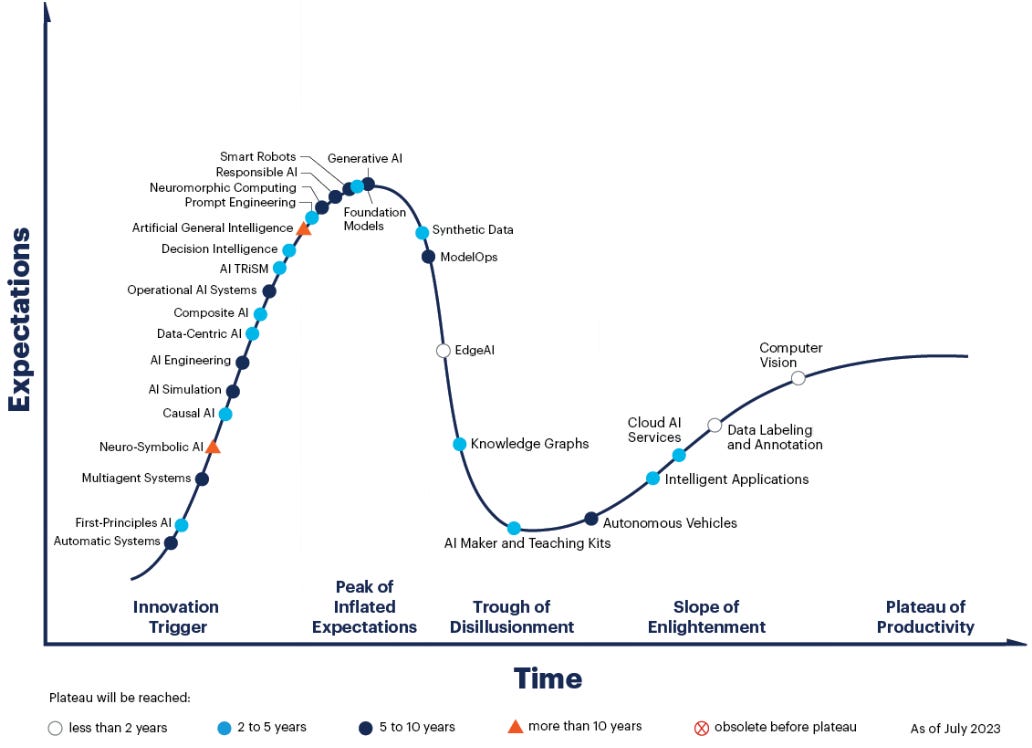
According to recent analysis, Generative AI has passed the Peak of Inflated Expectations and is starting to enter the Trough of Disillusionment.
What this means: The biggest investment boom (the peak) may already be behind us. The market is realizing that integrating AI is much harder and slower than just downloading an app. The easy money is gone. This “Trough” is not dark or dangerous, but it is the place where we figure out how to make something work or not work. It’s where the hard, boring, detailed work happens.
My Final Thoughts
The truth, as always, is complex and uncomfortable. It demands that we hold two conflicting ideas in our minds at the same time.
AI is not a bubble, but the valuation of AI is highly fragile.
We are not in 1999, when the technology was mostly just a promise. We are in late 2025, where the technology is a tool, and it is already cutting costs and increasing speed in many sectors (Side A). You cannot bet against this core transformation.
However, the prices of the companies leading this charge assume a perfect, fast, and smooth transition to the future.
They priced in the “Plateau of Productivity” when we have barely left the “Peak of Expectations.”
The current prices do not account for the coming Trough of Disillusionment, where many projects will fail, corporate budgets will be questioned, and that revenue gap will start to sting.
The risk is not that AI stops working. The risk is that the market realises the time needed to get from a working AI model to real, scaled, ethical, and profitable business use is much longer than the three to five years currently priced in.
For the long-term thinker: If you believe in the technology (which I do), any market dip (the Trough) is just a massive opportunity to buy the real winners at a fair price.
For the short-term investor: Be prepared for volatility. The “easy money” has been made by those who sold the shovels (the chips).
Now, those who bought the shovels must actually find the gold (the profitable business use cases), and that is a much harder, slower, and less glamorous task.
This moment is about separating belief in the future from belief in the current price. The future is bright, but the path there is going to be bumpy, full of bankruptcies, and probably quite disappointing for anyone who expects a straight line to success.
What do you think? How do you see and prepare yourself at this point?
This analysis clearly separates technological progress from market hype, showing that AI’s real value is already tangible even as valuations remain fragile and speculative.
I talk about the latest AI trends and insights. If you’re interested in seeing where AI’s real impact is versus the hype, check out my Substack. You’ll find it very relevant.