How to Win Any Conversation Without Saying Much
A reflection from Just Listen by Mark Goulston
Hej! It’s William!
This is part of the "Meller Highlights" series with reflections and learnings from my personal book highlights. I read a lot of books, and as a way of giving more value to my paid subscribers, I now share great book lessons specially for them.
If you’ve been following along and enjoying the ideas I share, I’d love to have you join them. Becoming a subscriber not only gives you full access, but it also helps me keep creating and going deeper with the work I do.
How do these highlights work? Every day, I pick one idea from my reading and think about how to apply it in real life. Most stay as private notes, but once a week, I choose one that feels special.
That’s the one I share here, a highlight that turns into a deeper reflection on how it can change the way we do something.
Today’s highlight: Just Listen by Mark Goulston
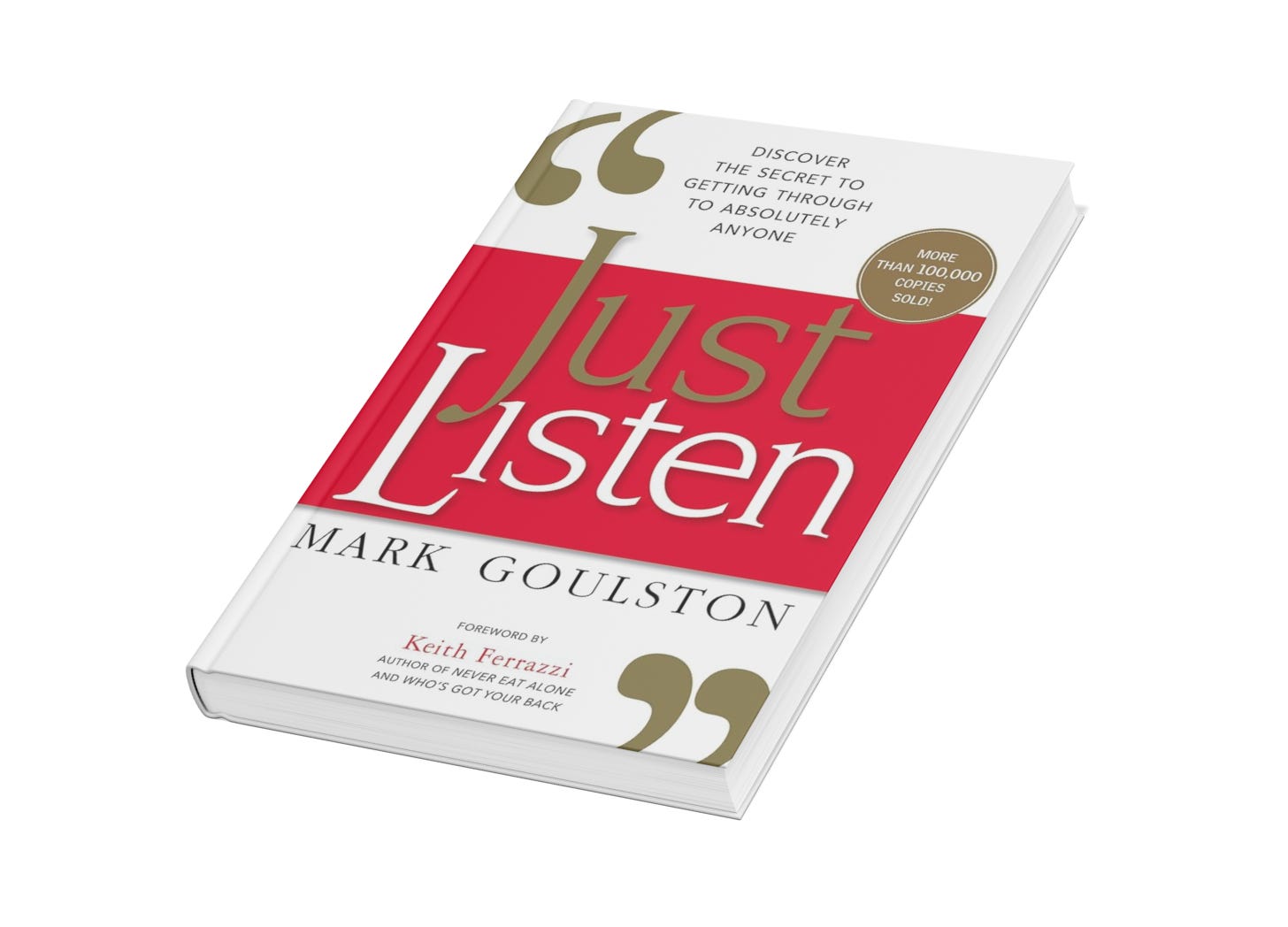
“Most people upshift when they want to get through to other people. They persuade. They encourage. They argue. And in the process, they create resistance. When you use the techniques I offer, you’ll do exactly the opposite—you’ll listen, ask, mirror, and reflect back to people what you’ve heard. When you do, they will feel seen, understood, and felt—and that unexpected downshift will draw them to you.”
Let’s reflect on that…
Most people believe connection comes from speaking well, from sharp arguments or carefully polished words. Yet, if you have lived long enough, you know that is rarely what stays with us. Words impress for a moment, but listening reaches deeper. It allows the other person to stop bracing, to stop performing, and to simply be.
Think back for a second. When was the last time you felt truly heard? Not the routine nods around a table. Not the hollow silence that presses you to finish quickly so someone else can take their turn. But a moment when the person across from you was entirely present, as if nothing else in the world demanded their attention.
If you have ever experienced that, you remember it not because of what was said, but because of what was not said. No quick solutions. No rush to teach. Just the rare gift of presence. It lingers in memory because it is so uncommon.
And here is the unsettling part: most of us spend our days surrounded by conversations, yet still starved of that kind of listening. We defend ourselves out of habit because we do not expect to be met with patience. We polish our own words because we assume they will be skimmed rather than absorbed. We perform, and others perform back.
This is why the act of real listening is not soft or secondary. It is an act of responsibility. It creates trust in a way no clever phrase or brilliant argument can. And it explains why people will often trust the quiet listener more than the eloquent speaker.
They did not correct you mid-sentence. They just stayed with you, attentive.
Maybe they asked one quiet question to understand better. Maybe they simply let your words hang in the air, repeating them back in their own voice so you knew they actually grasped what you meant.
That is real power, and we underestimate it. Because it is rare.
At work, this skill can transform a tough negotiation into a partnership. At home, it can turn conflict into understanding. Among friends, it can reveal truths we were afraid to say.
Yet we keep focusing on the perfect comeback, the winning argument, the impressive insight. We believe words will save us, but they often bury us deeper.
What if listening is the better strategy?
Not listening to reply, but listening so the other person can finally relax. So they can see you are not there to attack or judge, but to understand.
This is not just nice or polite. It is practical. People open up when they feel safe. Teams work better when everyone knows they will be heard.
Even in hard conversations, real solutions show up when people stop defending and start exploring.
It is not easy. We are wired to prove ourselves, to fix things, to avoid the discomfort of silence. But this is a skill we can practice.
So here is a real challenge for next time. When you feel the urge to interrupt, to persuade, to show how smart you are, stop. Take a breath. Let them finish.
Mirror what you heard. Ask one careful question. Reflect on what matters.
You might be surprised at what happens. Because connection is not built by the best talker in the room. It is built by the best listener.
So, what would change in your life if you decided to become that person?
This is part of the "Meller Highlights" series with reflections from my personal book highlights.