

How Infinite Scroll Is Quietly Compressing Your Life
Social media was not designed with your memory in mind. Here is the specific mechanism that is making your time disappear.

Before we start, you might think these notes are the end of the line, but they are actually just the starting point. If you find value in these reflections, you are likely missing out on the deeper, more specialized layers connected with this ecosystem built to improve you:
You Visible: For the professional who has the expertise but lacks the presence. This newsletter is designed to help you stop being a best-kept secret inside your company and start being a recognized voice for the world.
Project Management Compass: If you are tired of the “accidental” way projects are managed and want a structured roadmap for leadership and execution, this is where we get the best of Project Management and its world.
It happened to me last December.
I was looking at the calendar, and a cold little wave hit me. Not the deadline kind of panic. The stranger one.
The one that makes you ask if the last twelve months actually happened, or if you somehow skipped them without noticing.
I just stood there for a second. Where did the year go?
We have all felt this. And honestly, it is one of the more unsettling feelings a person can have, because it is not pain exactly. It is closer to absence, like reaching for a memory and finding fog.
There is even a name for it in psychology circles, time amnesia. And it is becoming one of the quiet struggles of modern life, this sense that we are running faster and faster while ending up with less and less to show for it. Exhausted, but somehow empty at the same time.
Here is the thing, though… This is not just a feeling… It has a real explanation. And once you understand what is actually happening, it stops feeling inevitable.
The Math That Is Working Against You
Let me start with something a little uncomfortable. Part of this is just arithmetic.
Psychologists call it proportional theory, and the idea is simple and a little brutal at the same time. As we collect more years of life, each new year becomes a smaller fraction of the whole. Which means it carries less psychological weight than the ones before it.
Think back to when you were five… A single year was 20% of your entire life.
That is exactly why summer vacations felt like they lasted forever, because relative to everything you had ever known, they basically did.
By your thirties or forties, that same year is closer to 3% of your journey.
The calendar did not get shorter. But your brain is measuring it against a much bigger whole, so it registers as lighter, faster, less significant.
That alone would explain the feeling. But the math is only half the story, because your brain has a second mechanism running in parallel, and that one makes things worse.
Your brain is, before almost anything else, an efficiency machine.
Its main job is to save energy, and one of the ways it does that is by filtering out anything it already knows how to handle. If a situation is familiar, the brain basically says “I’ve got this” and stops paying close attention. It does not bother recording what it already understands.
Take your morning commute. If you drive the exact same route every day, your brain eventually stops registering the details. It knows what happens. So it just lets the trip pass without really encoding it.
And here is where the hidden cost shows up. When your life becomes a string of repeated habits, the same meals, the same screens, the same weekly rhythm, your brain slips into autopilot. Nothing genuinely new is happening, so it has nothing worth recording. So it does not.
A week spent entirely in routine feels, in memory, like a single day.
That is not poetic exaggeration. That is how memory formation actually works. If nothing distinct happened, your brain treats the whole stretch as one undifferentiated event. And that is exactly what creates the terrifying feeling of a whole year vanishing without a trace.
The Algorithm That Pours Fuel on All of This
Now here is where it gets modern, and honestly, a bit more alarming.
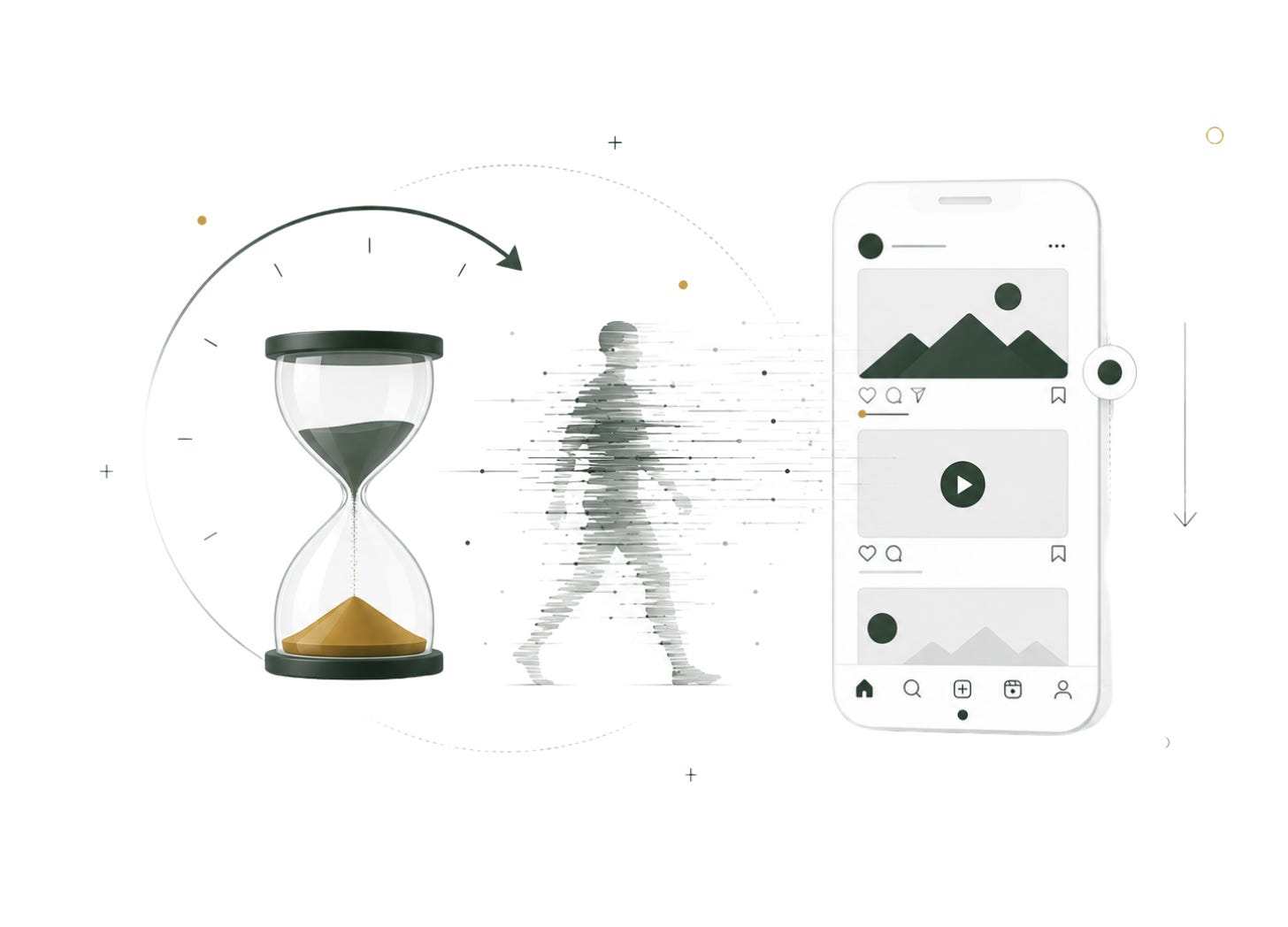
In the last decade, this natural biological compression got massively turbocharged by the thing we carry in our pockets every single day. And the mechanism is specific enough to name. Social media platforms are deliberately built around what psychologists call the removal of stopping cues.
A stopping cue is any natural endpoint that tells your brain an activity is finished. You reach the end of a chapter. You get to the last page of a magazine. The credits roll. Small as they seem, these moments do real work. They give your brain a pause, a chance to process what just happened and build a proper memory marker around it.
Infinite scroll removes all of that by design. The feed never ends, there is no signal that anything is complete, so nothing gets filed or consolidated. Two hours of scrolling registers in your memory about the same as twenty minutes, because to your brain it was all one continuous blur.
And the content itself is engineered to keep you in shallow dopamine cycling. Dopamine, worth understanding here, is the brain’s reward chemical, the thing that fires when something feels good or interesting. Short videos and fast posts trigger small, frequent hits that keep you engaged. But because the rewards are so quick and so similar to each other, your brain treats the whole session as one single low-resolution event.
It is like trying to light a fire while someone tosses a cup of water on it every two minutes. It is not that you are doing nothing. It is that nothing is ever allowed to catch.
The Exhaustion That Does Not Feel Like Rest
This is the part I find most relatable, and probably the part most people recognize but cannot quite name.
You can spend an entire evening on your phone and still end up exhausted and uninspired at the same time. That combination is not an accident. You gave your brain a huge amount of visual data to process, but none of it turned into anything meaningful or lasting.
Your mind was working hard. But because the content has no real depth, it never produced a genuine sense of achievement. There was no beginning, middle, or end. There was just more. And then it stopped. And now you are tired in a way that sleep might not even fully fix.
To actually feel rested, your brain needs activities with productive friction. The kind of meaningful effort that ends with a real sense of having done something.
That phrase is worth sitting with, because it sounds backwards. We tend to think rest means doing nothing. But neurologically, what creates the feeling of restoration is engagement that has structure and completion. A problem solved. A chapter finished. A conversation that went somewhere real.
Passive scrolling is the opposite of that. It is effort with no resolution.
The Kind of Life Your Brain Actually Keeps
So what do we do with all of this?
Slowing down the clock is not really about doing less. It is about doing things distinct enough to leave a mark. You have to give your brain something worth encoding, experiences new or challenging or meaningful enough that your mind decides to hold onto them.
Memory researchers call these anchors. Vivid, specific moments that stretch your perception of time in both directions, backward and forward, making a month feel full instead of hollow. A new place you visited. A skill you started learning. A conversation that genuinely surprised you. These are the pins on the map that make your timeline feel real.
A few concrete ways to start building them:
